
Grief doesn’t stay home. It walks into our classrooms, our staff meetings, our hallways.
You Don’t Have to Fix It
Supporting Grief in Students and Staff · A session with Gladys Jean Ullstam, Ember & Bloom Coaching
Whether you were in the room at the South Shore Learning Conference or you wish you had been, everything from the session lives here — the language, the practices, and where to turn for more. Take what helps. Leave the rest.
You are not trying to fix it. You are trying to not make them more alone in it.
Take the session with you
What grief actually is
It’s not a line. There are no stages to climb and no finish line. It moves in waves — someone can be fine at 9:00 and undone by 9:15. It lives in the body and the brain: lost focus, no sleep, a short fuse. And it shows up sideways — some pull away, some get sharp, some overfunction and look “fine” until they crash.
When you see it, reach for patience before the referral form.
Say the name
When someone dies, people stop saying their name. They think they’re protecting us. They’re not. The name is the proof they existed. A student won’t fall apart because you said their person’s name — they’ll fall apart because no one is willing to.
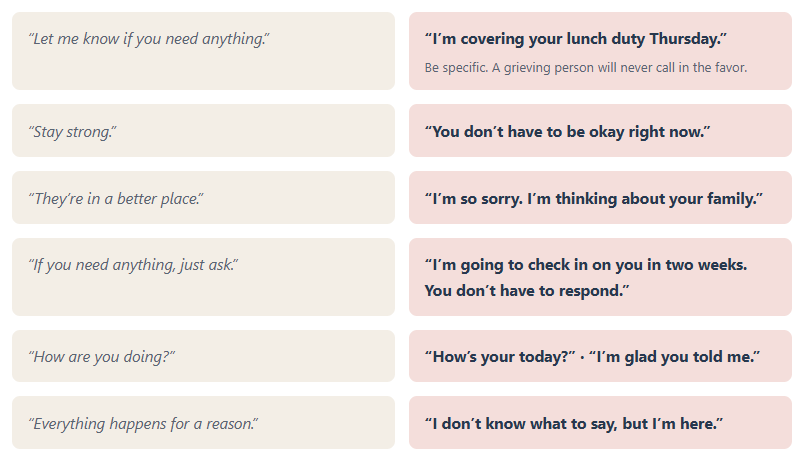
The language, side by side
The same care, said two ways. The column on the right is what tends to land.
The second time counts more
Most people say something once — at the funeral, in a card, the first week — then go quiet. The grieving person doesn’t need more first-time condolences. They need someone still saying their person’s name three months later. Six months. A year. “I was thinking about your family this morning,” in October when no one else is saying it — that’s the one they’ll remember.
Where to turn
If someone is in crisis right now: call or text 988 (Suicide & Crisis Lifeline, free and 24/7 — you don’t have to be suicidal to reach out), or text HOME to 741741 (Crisis Text Line). Call 911 for immediate physical danger.
Coalition to Support Grieving Students Free, educator-specific resources and short video training. Start here.
The Dougy Center Support for grieving children, teens, and families, plus a school & community toolkit.
National Alliance for Children’s Grief Guides for schools and a directory of local children’s grief programs.
Soaring Spirits International Community for widowed people, including Widowed Village and Camp Widow.
GriefShare Local, faith-based grief support groups.
A few good reads
It’s OK That You’re Not OK (Megan Devine)
Life, Reconstructed (Teresa Amaral Beshwate)
The Grieving Student: A Guide for Schools (Schonfeld & Quackenbush)
The Invisible String (Patrice Karst)
Who I am
I spent more than twenty years in K–12 as an instructional coach and reading specialist — in your hallways, in your staff meetings. My husband Gary died on November 27, 2021, the Saturday after Thanksgiving. I’m not here as a clinical expert. I’m here as Gary’s widow, and as someone who walked back into a school carrying grief no one could see. This session is what I wish more of us had known.
If this stayed with you
I coach widows through grief at Ember & Bloom, and I offer a free conversation called Holding the Ember — no agenda, just a place to start. If you’d like to bring this session to your own school or district, I’d love to hear from you.