
Introducing The Shore Pause, a gentle two-minute practice for moments when grief feels overwhelming.
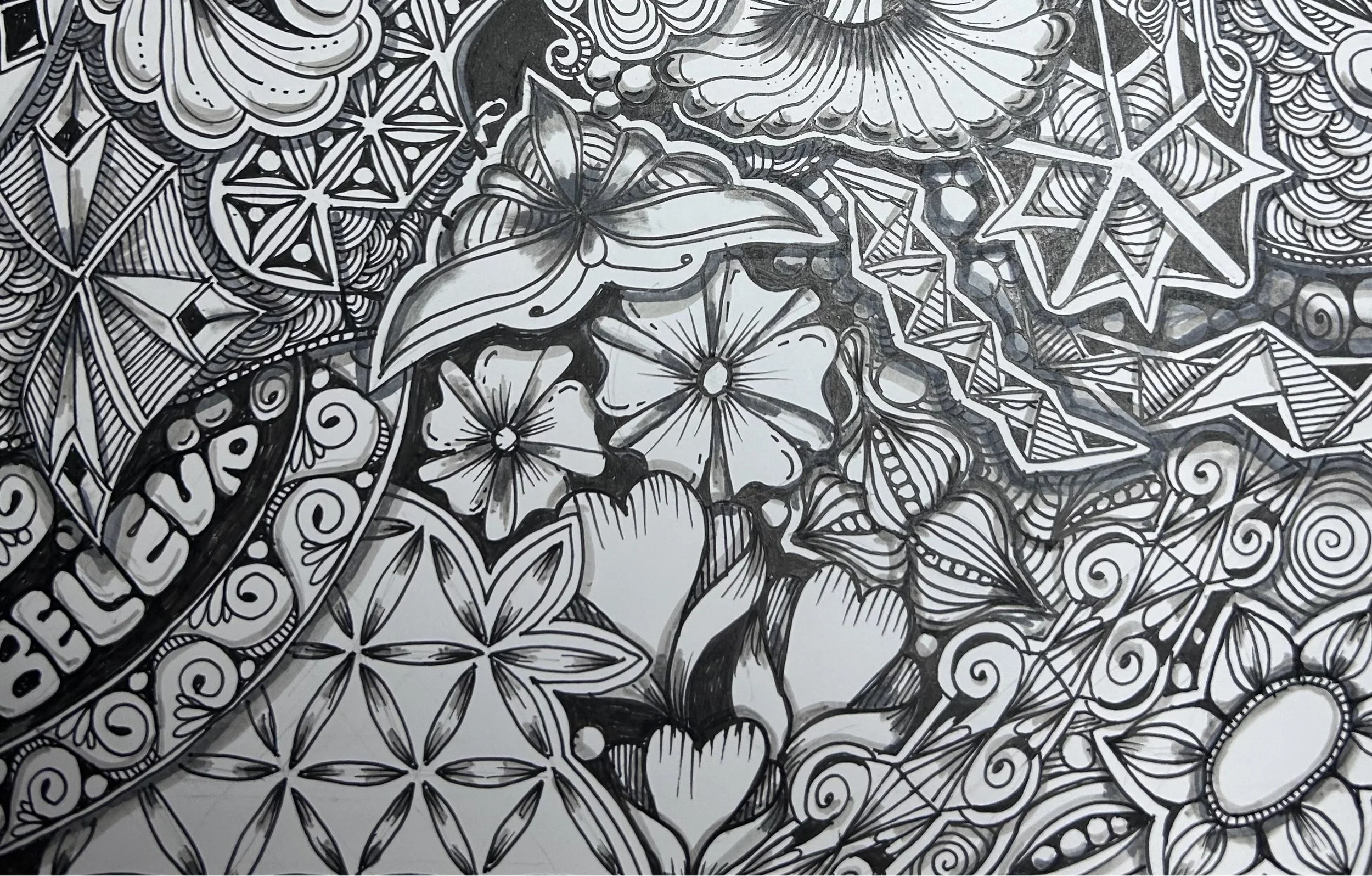
One line at a time, simple patterns become something more. My Zentangle artwork reminds me that creativity isn't about the finished piece, but the experience of creating it.
Artwork by Gladys Ullstam, CZT.
Grief can feel like being swept along in a river.
Our thoughts race. Our emotions pull us in different directions. Memories surface unexpectedly. Sometimes we're so caught up in what's happening inside us that it's hard to see anything clearly.
When we're in the middle of it, we don't always need someone to tell us how to get out.
Sometimes we just need a place to land.
Simple creative activities, like drawing repetitive patterns, can help us slow down and bring our attention into the present. The movement of a pen across paper can give us something gentle to focus on, without asking us to explain or change what we're feeling.
That's what mindful drawing has offered me in my own grief journey, and it's what inspired me to create The Shore Pause.
In a recent post, Using Art in Grief: How Creativity Gives You Room to Breathe, I shared how creativity became an important part of my life after my husband, Gary, died. I wrote about drawing, journaling, and music, and how making art helped me find moments of calm when grief felt overwhelming.
Today, I'd like to do something a little different. Rather than just talking about creativity, I'd like to invite you to experience it.
It takes only a couple of minutes. You don't need to know how to draw, you don't need special supplies, and you certainly don't need to create anything beautiful.
Just a pen, a small piece of paper, and a little curiosity.
How Drawing Helped Me Navigate Grief
After Gary died, I noticed something interesting.
My thoughts seemed to take on a life of their own. One would lead to another, and before I knew it, I was caught up in memories, regrets, worries, or the sheer enormity of living without him.
Sometimes I could recognize what was happening. Other times, I was so caught up in it that I couldn't see beyond what I was feeling.
But I began to notice that when I picked up a pen and drew simple, repetitive patterns, something shifted.
I wasn't trying to make anything special.
I wasn't trying to figure out my grief.
I was simply following one line with another.
And another.
My attention had somewhere to land. Instead of following every thought, I could focus on the movement of the pen, the shape of a line, or the rhythm of a pattern.
Sometimes my breathing slowed. Sometimes I felt a little more settled. Sometimes I simply enjoyed having something gentle and absorbing to do.
The grief hadn't disappeared.
But for a few moments, I could be with it differently.
Why Repetitive Drawing Can Feel Comforting in Grief
In that earlier post, I mentioned Zentangle, a method of drawing structured patterns one stroke at a time. It's a practice I love so much that I went on to become a Certified Zentangle Teacher.
What draws me to it is its simplicity. You don't have to imagine a finished piece or decide what to draw next. You can follow a few steps and let the pattern develop.
One of the first patterns I learned was called X Flower. I stumbled across it in a YouTube Short. It isn't an official Zentangle pattern, but it shares many of the qualities I love about tangling: simple strokes, repetition, and the freedom to let something emerge one line at a time.
It's still the pattern I return to when I need comfort. My hand knows what to do, and my attention can settle into the process.
When we're grieving, our thoughts can jump quickly from one memory or worry to another. Repetitive drawing gives our attention something concrete to hold onto: the movement of our hand, the pressure of the pen, the rhythm of repeating a line.
It didn't take away my sadness or stop me from missing Gary. It simply gave me a few moments when I wasn't being pulled along by every thought.
I've come to appreciate how much this mirrors something I've learned about grief.
We don't always have the capacity to look far ahead. Thinking about next week, next month, or the rest of our lives without our person can feel like too much.
But we can often attend to one small thing.
One breath.
One line.
One next step.
And sometimes, that's enough for now.
Introducing The Shore Pause
The Shore Pause is a simple pen-and-paper practice that grew from something I once heard: You cannot see the river when you're in it.
I don't remember where I first encountered those words, but the image stayed with me.
When we're caught in the current, it's difficult to see what's happening around us. But if we can step onto the shore, even briefly, we may find a little space to notice.
That's what The Shore Pause offers. Not a way to stop the river or make grief disappear. Just a small opportunity to step out of the current of racing thoughts and give our attention somewhere gentle to land.
At its heart, the practice is very simple:
Pause. Breathe. Create. Notice.
And I'd love for you to try it.
A Simple Two-Minute Drawing Exercise for Grief
Find a comfortable place where you can sit for a couple of minutes. You'll need a pen and a small piece of paper. A sticky note or an index card works beautifully.
1. Pause
Take a moment to notice where you are. Feel your feet on the floor, the chair beneath you, and the pen in your hand.
There's nothing you need to accomplish right now.
2. Breathe
Take three slow, comfortable breaths. You don't need to breathe in any particular way. Just allow yourself a moment to arrive.
Notice how you're feeling, without trying to change it.
3. Create
Begin making a few simple marks on your paper.
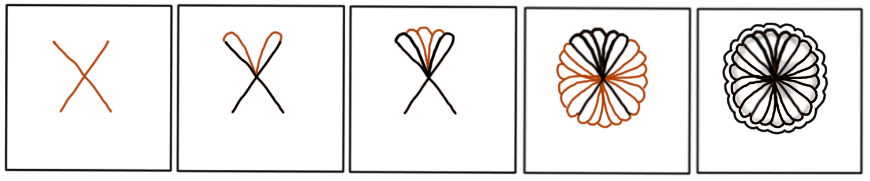
You might try an X Flower:
Draw a large X.
In the top space, draw a curved petal from the tip of each arm down into the point where the lines cross.
Keep adding petals, working in from both sides, until they meet in the middle.
Do the same in each of the other three spaces until the petals form a full circle.
Draw an aura (an outline) around the whole flower.
Or you might draw circles, swirls, dots, or repeating lines. Choose something simple enough that you don't have to think too hard about what comes next.
Let your pen move slowly. Notice the pressure of the pen against the paper, the movement of your hand, the shapes appearing in front of you.
One stroke at a time.
There are no mistakes and no wrong answers. You don't need to finish anything.
4. Notice
When you're ready, put down your pen. Take a moment before moving on, and ask yourself:
What am I feeling right now?
What might I need in this moment?
What's one small next step?
You don't have to answer every question.
You may notice that you feel calmer. You may notice that you're still sad or restless. You might feel exactly as you did when you began.
That's okay. The purpose isn't to achieve a particular feeling. It's simply to pause and notice what's here.
It's Not About Making the Grief Go Away
I don't believe we need to distract ourselves from every difficult emotion. Our sadness, longing, anger, and fear aren't problems in and of themselves. They're part of our experience, and they deserve our attention and care.
But sometimes those feelings are so intense that it's difficult to know what we need. A small creative pause can give us an opportunity to notice.
Perhaps we discover that we're exhausted and need to rest. Maybe we recognize tension in our shoulders, or realize that we need to call a friend, take a walk, have a good cry, or simply sit quietly for a while.
And sometimes we don't discover anything at all.
That's okay, too. We don't have to turn every experience into an insight or a lesson. Sometimes the experience itself is enough.
Creativity Is an Invitation, Not Another Thing to Do
As I explore bringing creativity into my grief coaching, I'm mindful that grieving people already carry so much. The last thing I want to offer is one more thing you feel you should be doing.
The Shore Pause isn't homework. It's not a challenge to complete every day. And it's certainly not a test of artistic ability.
It's simply something you can have available when you feel drawn to it.
You might keep a small stack of paper squares and a pen beside your favorite chair, or tuck a little notebook into your bag. Perhaps you'll reach for it when your thoughts are racing, after a difficult conversation, or on a day when you're missing your person especially deeply.
Or perhaps you'll discover that drawing isn't for you, but another creative practice offers a similar experience. That's worth noticing, too. We're all different, and what helps one person may not feel helpful to another.
The invitation is to stay curious about what supports you.
Let's Keep Exploring Together
Creativity has offered me so much throughout my grief journey, and I'm becoming increasingly curious about what it might offer others. I keep returning to the same idea: we don't need to fix our grief to care for ourselves within it.
Sometimes we need words. Sometimes we need connection. And sometimes we need a pen, a small piece of paper, and a few quiet moments.
The Shore Pause is one small part of that exploration. In the coming weeks and months, I'll be sharing more creative ideas and invitations. Some may involve drawing; others, writing, music, or different ways of engaging our senses and attention.
You won't need to be artistic to participate.
Just curious.
And I'd love for this to be a conversation. If you try The Shore Pause, I'd love to hear what you notice. Did it feel comfortable? Did you enjoy the repetition? Did anything surprise you?
Or perhaps you already have your own version of a Shore Pause, a simple activity that helps you feel a little more grounded when grief feels overwhelming. I'd love to hear about that, too.
Share your experience in the comments, or simply take a moment to reflect on it for yourself.
Because sometimes we don't need to know how to navigate the entire river.
Sometimes we just need a place to land.
One breath.
One line.
One small moment at a time.
💜💚
About the Author
Gladys Ullstam is a grief coach, widow, and Certified Zentangle Teacher (CZT). Through Ember & Bloom, she supports widowed people navigating life after the death of a spouse. Her own experience with grief and creativity inspires her exploration of simple creative practices that invite reflection, self-compassion, and moments of steadiness.